
How We Rank
How We Rank
What goes into the Prep Gymnastics rankings? How can you get on to our radar? Why did someone move down?
Check out the sections below to learn about how our rankings are determined.
- Purpose & Standards What's the mission of our rankings? Learn More
- What Are You Looking For? Our criteria for evaluating athletes. Learn More
- Why Did My Ranking Change? Figure out why someone was moved down. Learn More
- Exposure Tips Ways to improve your chances of being evaluated, move up, and use the rankings as a tool. Learn More
- Frequently Asked Questions Everything else we may have missed. Learn More
- Purpose & Standards A message from Prep Network CGO Nick Carroll. Learn More
Purpose & Standards
Our rankings exist to bring exposure to the maximum number of athletes pursuing the recruiting process, with a chance to play at the next level.
Our Scouts are tasked with filtering out athletes who haven’t shown traits that translate to the next level, but we don’t pride ourselves on exclusivity. We’re trained to recognize the potential and value that each athlete brings to the competition.
| Name | Players Ranked |
|---|---|
 Prep Gymnastics
|
100 |
Our Scouts pride themselves on how well they know the sport. We put a lot of time and energy into putting athletes in order and are as diligent as we can be to get it right.
The most important guideline for our Scouts is that the rankings are a projection of someone’s future collegiate potential, not a reflection of their current ability.
In the same way that the Heisman trophy winner doesn’t get picked first in the NFL Draft every year, the high school athlete of the year also isn’t always our #1 ranked prospect. We have plenty of room in our articles to recognize high school accolades and statistical achievements. The rankings, however, should give readers an idea of how athletes will perform at the college level.
The standards above and in the links below outline the expectations. These expectations are shared with our scouts and championed by the editors. We will continue to do the best we can and work to improve areas where our credibility has been questioned.
Finally, we owe it to our audience to explain what changed in each update, why athletes move down, and what we’re looking for in prospects. Please tune into your site post-update to see who the New Additions and Stock Risers are in each update.

Our Criteria
On one hand, it’s quite simple:
- Athleticism
- Skills required at your position
- Gymnastics IQ
- Intangibles
- Toughness
- Productivity
On the other hand, all of our scouts place slightly different levels of value on each of those categories.
Most importantly, though, gymnasts are ranked on their potential as college recruits. The rankings are not based solely on performance in competition.
If a gymnast is more athletic, powerful, or physically gifted, that can compensate for current technical deficiencies. There’s an old adage that athletic traits are difficult to teach, while skills can be developed over time. If you look across the different levels of collegiate gymnastics, the difference is very rarely basic skill level alone. The biggest gaps are often in power, athleticism, body control, and the ability to perform under increasingly demanding competitive standards.
This distinction between competitive results and collegiate potential is a huge one and where we see parents and athletes get hung up the most. There are countless gymnasts with outstanding scores and accomplishments who ultimately compete at lower collegiate levels, while late bloomers who may not fully break through until later in high school develop into highly sought-after Division I recruits.
College recruiters and Prep Gymnastics scouts are looking for routines and flashes of athleticism that translate to the college level. Sometimes a gymnast may only have a few moments in a meet that stand out on paper through scores or placements. But if there are one or two displays of extraordinary athletic ability during the competition, there can be a difference in how those performances are evaluated, and that is reflected in our rankings.
Some scouts may value competition results and scores more than others, and that’s absolutely allowed. It is a skill to compete and perform well. At the same time, gymnasts need to be able to compete athletically. The bar for athleticism continues to rise at the collegiate level. In order to be successful in college, you’ll need the requisite athleticism, power, and physical tools, whereas many technical skills can be developed. So those differences, again, are reflected in our rankings.
Why did my ranking change?
We would never publish an article dedicated to the specific gymnasts who moved down in a rankings update. Our site is here to celebrate athletes’ achievements and abilities. But the reality is that many gymnasts do drop on the list with every update. The question will inevitably arise, as it always does when we update the rankings: “Why did she get moved down?”
It’s a fair question, but in reality almost nobody is moved down the list on purpose. Rather, they’re passed by newcomers who have made a big impact since the last rankings update and by gymnasts who have improved their standing. We shouldn’t say it never happens, but gymnasts are only moved down in the rankings in the case of some extraordinary negative occurrence. For example, a gymnast who leaves their club program in the middle of the season for no apparent reason. A gymnast who gets in some kind of serious trouble inside or outside the gym, for example.
“Wait a minute,” you might say. “My daughter went from 75th to 85th. She was definitely moved down.” Actually, that’s not what took place. What’s happened is that she has been passed in the rankings by others who have done more.
How it works
Let’s use a hypothetical example. Say a gymnast – let’s call her Sam Thomas – is currently ranked #75 in her class. Sam has had a good season so far but hasn’t exceeded expectations, hasn’t added significant new difficulty, hasn’t made major strides in her athletic development. None of this is unusual for a young gymnast. Given that nothing has really changed, shouldn’t Sam still be ranked #75? Not according to the math. Why? Because there are always newcomers who work their way into the rankings. And there are always gymnasts who have exceeded expectations, who have added significant difficulty, who have improved their execution, consistency, and overall athletic development.
If 25 new gymnasts are added, and three of them are ranked higher than Sam, that now puts Sam at #78. If three gymnasts have raised their stock enough to move ahead of Sam, that means Sam is now at #81. In other words, by maintaining her current level of performance, Sam got passed by sicfother gymnasts.
Let’s review the math. First we’ll add the three newcomers with their rankings:
#55 – Newcomer 1
#65 – Newcomer 2
#72 – Newcomer 3
After these insertions, all ahead of Sam, her ranking changes from #75 to #78. Now we factor in the three hypothetical gymnasts who raised their stock.
Jordan Timmons goes from #85 to #55
Jesse Smith moves up from #78 to #68
Logan Jones improves from #80 to #70
What does this do to Sam Thomas’ ranking? Unfortunately, Sam moves from #78 to #81. The numbers don’t lie.
Let’s face it: Athletes separate themselves all the time in every respect. For example, some gymnasts make major gains in strength, power, and difficulty. Some don’t. While being an early standout isn’t a liability at a young age, it can become more challenging as other athletes continue to develop. There’s nothing you can do about it, of course, but it is a recruiting reality that athletic development matters. A ton.
A large number of gymnasts tend to hit their stride in the 10th and 11th grade. Those whose athletic development takes off a little later frequently find a new level of confidence and consistency. Gymnasts who have invested in their skill development start to show the fruits of that labor against stronger competition. Others stagnate. Plateau. Level off. Whichever term you want to use, we often see early bloomers tail off and later bloomers take off.
So your daughter sees her ranking go from #88 to #95, this is why it happened.
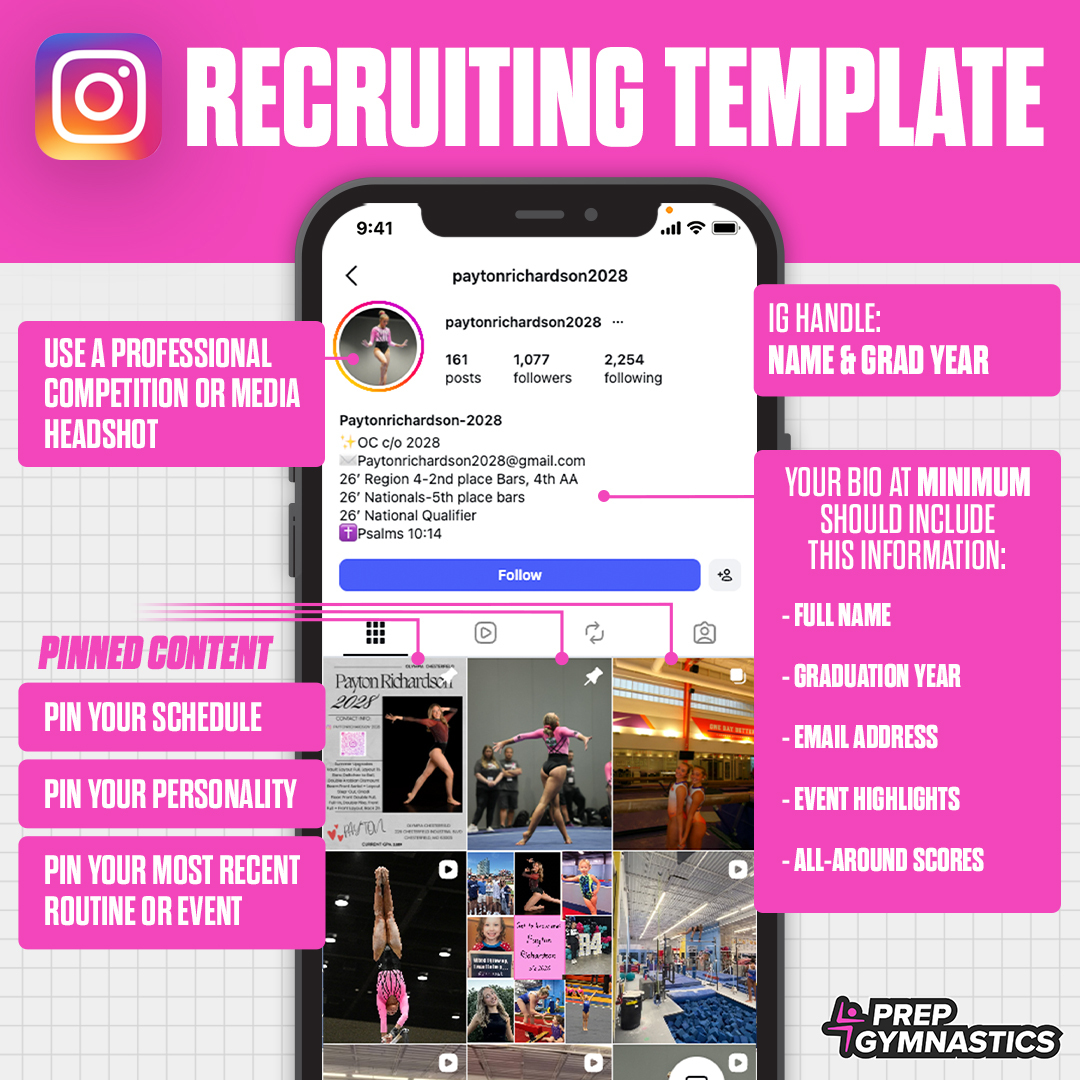
Exposure Tips
Tips to improve your chances of being seen, and therefore ranked, by Prep Gymnastics:
- Compete in club and offseason events. In order to rank you, we not only need to know of you, we also need to see you play.
- Send information to our scouts. They’re also on social media! You don’t need to ping them every month — in fact we advise against being overly communicative — but keep them up to date with your highlights and schedule by sending it to them via direct message.
- Excel on social media. Use your real name. Put your high school, club team, position, accurate size, and GPA in your bio. Link to your highlight videos. Pin your schedule.
I am already ranked or I’ve already been evaluated by your scouts. How can I improve my standing:
- Ultimately you are the common denominator in your recruitment. If you’re really a top prospect, if you’re sharp when the pressure is on, if you’re putting in the work away from the public eye, your standing will improve and you will be recruited. Irrespective of our rankings, you will get recruited if you’re a college-level talent. Take care of what you can control and all of the rest of these tips are extra additions to the most important piece: your work ethic and ability to play.
How to use the rankings as a tool:
- Claim or create a profile on Prospect Index. This gives every prospect the ability to control their athlete profile. From fixing the spelling of their name, to the school they attend, to updating their college offers – prospects & their families will be able to do it all. Additionally, the Prospect Index will allow athletes & their families to provide accurate contact information that will be visible to college coaches across the country, making it easier for them to reach out directly if they are interested.
- Share a screen-shot of your athlete profile on social media! While rankings are not the be all, end all, they are a great database for college coaches and scouts trying to navigate the massive scope of the recruiting landscape. Signaling your ranking online to college scouts could help them understand that you should be on their recruiting board!
- When reaching out to college coaches, link your Athlete Profile in your email. We have plenty of college coaches who subscribe and are familiar with navigating our website. Feel free to link articles, social media, and videos our scouts have on you in your communication.
Frequently asked questions
- How did you leave so-and-so off the list?
-
We can only rank and re-evaluate the athletes we see, mostly through live viewing. The flip-side of this is that we're unable to see everyone. We try our best but it haunts us to know that there are capable athletes who are currently not in our rankings either because we haven't watched them or caught them on an off night. Because of this, we update our rankings 3 to 4 times a year to keep up with the pace of how often athletes emerge.
- Can I pay for preferred coverage or a spot in the rankings?
-
No, you cannot. Our list is based strictly on merit, not whether you signed up for a profile or participated in a particular event.
- Do athletes from certain clubs or teams get preference?
-
No they do not. A variety of clubs and teams are represented in all of our rankings. While playing for a more high-profile team will probably get you seen earlier and perhaps promoted more via the club's social media, it won't determine where you fit in the prospect pecking order.
- Our family doesn't live in a major city. Will my daughter be seen?
-
Most likely. Our scouts take pride in covering the entire state. The proliferation of online viewing options has definitely helped kids from the more remote corners of each state get seen earlier and more often. Also, our scouts are expected to keep sources in hard-to-reach areas. Our network of observers has grown a lot over the years and we are confident that we are looking at the best athletes across the state.
- How often are rankings published?
-
Rankings are expected to be published 2 to 4 times a year. We work diligently with our existing staff to stay on schedule with timely updates. In the few states where we don't have a team capable of ranking credibly, we're working to find a team of people to get their market up to speed.
- Why do you update so often?
-
Athletes emerge constantly. These are athletes in their teenage years where growth spurts, skill development, and playing opportunity occurs at varying timelines. To keep up with the rapid and random nature of athlete development, we feel that frequent updates are our best chance at accuracy. Humility also drives the frequency of our updates. We know that the rankings are never going to be perfect — that's an impossible standard and we cannot reevaluate every single athlete in the state between every update. Again, updating often gives us the best chance to keep up.
- Why don't you publish the names of all the people involved in the rankings process?
-
Other than the participation of our scouts/writers, the process is anonymous. Evaluators provide fair and honest input because they know it will be kept private. If their names were made public it would have a chilling effect on the process. Anonymity breeds accuracy in our opinion.
- Does an athlete need to compete year-round to get ranked?
-
No, but it definitely helps. Athletes who don't participate year-round are passing up the exposure opportunities — and the best exposure opportunities when it comes to basketball, volleyball, and soccer. If you really want to play at the next level, you need to make every effort to participate in at least a few events. Think of it this way: Playing at your local high school is like a manufacturer that only sells its products at the local corner store. Playing club is like having a store at the Mall of America. More eyeballs equals more exposure equals better odds of being seen by the right people at the right time. Completing yearround is also an indication that an athlete is serious about making it to the next level.